‘How I learnt English’: Part II

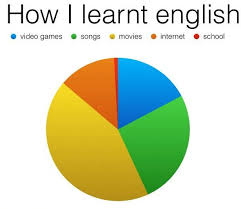
How I learnt English - graphicIn my previous post, I focused on the use of songs and videos in order to make the learning experience in the classroom more similar to the reality of our students outside the classroom. In this post, I will examine how other aspects, such as video games, can be brought into the classroom, and look beyond the graphic to see how to incorporate other learning experiences into our repertoire.

Gamification

The comments which accompanied the original graphic (above) focused almost exclusively on video games as a way of learning English, although the focus seemed to be more a reminiscence of games which the people had enjoyed than a coherent explanation of how the games had in fact helped the person to learn English. However, there is a movement to introduce ideas taken from the gaming world into the classroom, an approach referred to as ‘gamification’.

One of the main areas in which gamification is being applied to education, as we have seen in the video, is assessment. It is argued that the shift from marking negatively to a system where marks are accumulated like experience points is highly motivational. An example of how to organise activities in this way can be found in Rose Bard’s ELT Blog. But there are other aspects of classroom life where gamification can be applied, such as classroom management. Class dojoMany years ago, I worked with a teacher who had her class divided into teams and during her lesson she awarded points to the different teams according to how they achieved the objectives she proposed. She used to record the points on the blackboard, but today’s teachers have alternatives available which are more appealing to their video-game-playing pupils – for example, Class Dojo. With this programme, students can choose and personalise their own avatars, and the teacher can assign points for different actions. Each student can access his / her profile and keep track of their progress, and what is more, parents can also access the profile and see how their children are doing at school, all in real time. More importantly, this programme is used to modify the behaviour of the students in a way which motivates them, rather than imposing norms.
However, perhaps the most important aspect of gamification is in the approach to the class itself on the part of teachers and students alike. The essence of the video game experience is that the player explores and investigates, learning and honing skills as they go. If they fail at a level, they can repeat it, using the knowledge they gained on previous failed attempts to improve their performance. DPiE-InClass-400x258They also have the opportunity to cooperate with friends, either by discussing the games or increasingly by playing together in a multi-player format. Our objective as teachers, then, would be to recreate these conditions in the classroom, proposing challenges or problems which our students have to solve, then providing the scaffolding they need as they work through them. Clearly this is very different to the traditional format of class which we are accustomed to, and it can be difficult to adapt to it, but it can pay dividends. I think it is particularly important for students to try again if they do not succeed first time. Too often when we correct an exercise we give the correct answers, then ask who got them right. An approach I have developed is to ask them what answer(s) they have, and if they do not all agree on the right answer, I ask them to think again, talking it over with their peers, rather than give them the answer directly. This allows them to explain the reasons for their answers and hear counter-arguments, analyse more closely the question and practise reaching a consensus.

The most radical form of gamification for the classroom is the creation of actual games which put your students into situations, either individually or in groups, where they have to communicate in English in order to progress. There are various logogames of this kind already on the market, in which the student takes on the role of a character and has to use his/ her language skills to negotiate their way through a game world in order to achieve an objective. A good example of this genre is Pulitzer, a game in which the student takes on the character of a journalist who is set various assignments.

Other games and activities are available on the internet, so we don’t have to have lots of free time in order to develop a game ourselves. For a list of resources available for language learners of all levels, click here. It’s a good idea to contact the publishing companies too, as they are increasingly producing more game-based online elements to complement the text books they provide.

A step further…

Michael J Fox

Both this post and the previous one have focused on introducing new elements into the classroom in an attempt to increase the motivation of our students. However, some experts advocate going further and introducing a completely new way of approaching the class as a response to what they see as the failings of the traditional classroom.

Cooperative learning

One of the results of advances in neurological science is that we have a clearer idea of how we learn, and this is washing back into how we teach. Cooperative learning claims to provide ‘brain friendly learning’ for our students, and incorporates  various recent methodological ideas. In the cooperative classroom, students are grouped in mixed-ability teams, typically of four, and the lessons are designed in such a way that students are given opportunities to interact within their teams in a structured way. The key difference between this approach and group work is that students in a cooperative team each have a defined role within the structured interaction, and so are obliged to participate in order to complete the task.

The main principles behind cooperative learning are these:

  • The members of the team must work together, and are interdependent.
  • Each individual member of the team should have personal responsibility for his / her part of the work and should be accountable to the team and to the class for their work,
  • All members of the team must have equal opportunities to participate.
  • Work can be realised simultaneously in different teams, allowing more students to be actively engaged on a task at any one time.

The flipped classroom

One of the most radical advances in methodology has been made possible by advances in technology and by its widespread availability. The concept of the flipped classroom rose from ventures such as The Khan Academy, where the actual teaching, or instruction, is delivered via recordings online which students study at their own pace for homework, freeing up class time for guided practice exercises and problem solving. The advantages are that the teacher is primarily available in the classroom for individual support, able to work with students one-on-one or in small groups while the others are engaged in the activities, and students can repeat parts of the instructuion until they understand it, even revisiting the ‘class’ later on to refresh their memories. Here is a video which explores the concept of the flipped classroom:


Happy Birthday! Top five posts this year.

birthday-cake-ideas-1-1-s-307x512


David’s ESOL Blog is one year old today, and we have also just reached a total of 21000 views. I would like to take this opportunity to thank everyone who follows this blog or has visited it and contributed to its success. To celebrate, here are the top five posts from this first year:

1.  How I learnt English … and how I didn’t.

How I learnt English - graphic

I came across this graphic on Facebook recently and, as an English teacher, it depressed me a great deal, especially when I went to the original page and read the comments, as person after person spoke of the video games which helped them to learn. While it is great that they have been able to learn, and that they have taken responsibility for their own learning, as a teacher I feel bad that this is the image that at least some students have of our work. So for the past few days I have been thinking of ways to redress the balance. Luckily, there are many ways in which we can incorporate elements of what the students identified as helping them to learn English into their mainstream classes… (read more)

2. Speaking exams: What to do … and what to avoid.

As the main external exam season starts, I thought this would be a good time to write a post giving tips for how to approach the speaking exams in particular. To kick off, here is a new video from Cambridge English TV with some useful ideas about answering questions in the speaking tests… (read more)

3. Getting Them Speaking: Activities for the conversation class.

Getting them speaking 1 (TESOL Greece)

In this workshop, my aim was to demonstrate a series of activities which can be used in class as a way of encouraging our students, particularly teenagers, to develop their speaking skills… (read more)

See also: XXVII Jornadas GRETA, October 2013

4. Picture dictations.

Day five of the Five days five posts series, and unfortunately this is just post four. I’m writing this on the train bound for Córdoba, where I am giving a workshop on speaking activities for teenagers at the XIV Jornadas CETA (Córdoba English Teachers Association)… (read more)

5. How to … exploit video in class.

Watching video in class

Picture credit: Vimeo

It should be a motivating experience, indeed you may even have conceived the activity as a prize, or an end of term treat, but too often the use of video in the classroom has the opposite effect. In this post we will look at some different ways to incorporate video in the classroom, in a fun and, hopefully, motivating way… (read more)


XXVII Jornadas GRETA, October 2013

A year ago, on my way home from the XXVI Jornadas GRETA, this blog was born. Yesterday the XXVII Jornadas GRETA ended, and I have a moment to post the links to the presentations of my talks before heading back to Madrid.

GRETA Conference 2013But before talking about my own presentations, I would like to take this opportunity to thank everyone for a very enjoyable conference. Thanks to the speakers whose talks and workshops I attended – Dr Jesús García Laborda for his insights into the new Bachillerato test which is causing so much uncertainty at the moment here in Spain, Jane Skellett for her wonderful hamburger analogy for a genre approach to FCE writing (and a welcome reminder of how great the Meg and Mog books were!), Trinidad Jerez for sharing her ideas for getting the most out of IWbs and iPads in the classroom, Natàlia Maldonado for eight guiding principles for teaching CLIL science, and of course the irrepressible Chris Roland for more insights into the thorny issue of classroom management and discipline. And very special thanks to the organisers – the ‘girls in black’, particularly Rocío, who looked after me so wonderfully in my sessions, Antonio and most particularly Charo Reyes, without whose titanic efforts none of this would have been possible.

This year I gave two presentations, one o Friday and one on Saturday. My Friday session was on the use of cohesion and Halliday and Hasan’s idea of ‘texture’ to help students to improve their reading and listening comprehension. You can access a PDF of the presentation here.

On Saturday, my workshop was on speaking activities which I have used with teenagers, from practising questions to games involving extended speaking. A PDF of this presentation is here, and there are links within the PDF to other posts in this blog where the different activities are explained in more detail.

Now I’m off for a brief visit to this beautiful city, before once again I have to head back to Madrid.

DSC_0127

4 Things to Promise my Students at the Start of This School Year

A classroom in a Japanese high school

(Photo credit: Wikipedia)

Another school year has got under way, laden with high hopes and good intentions. But as September gives way to October and we settle in for the long haul, it is all too easy to let those good intentions slide and fall back on the routines we feel comfortable with. So this school year I have decided to go public – in this post I will set out four things I hope to make an integral part of my teaching this year, and over the coming months I will revisit these themes to let you know how I am getting on.

1. Make homework more interesting

Homework is always a thorny issue for any teacher. What should you set? How much? How should it be checked or evaluated? And what do you do with those students who refuse to do it? Most of the time the students perceive homeworksleep-on-books-1.10.12 as dull, and often even a waste of time, however carefully you programme it into your learning objectives. So this year I hope to follow Adam Simpson’s sound advice in his post ‘6 great techniques for getting students to write down their homework‘.

In particular, Adam’s suggestion to ‘Tech it up’ appeals to me. Our students are so-called ‘digital natives’, so a clear way of making homework more appealing to them is to incorporate digital elements where possible. This opens up the possibility of including listening comprehension tasks or watching videos and doing comprehension tasks as homework. Or perhaps an editing or peer response activity using Google Drive? Or even a class blog? Watch this space!

2. Give them space to learn

DPiE-InClass-400x258

Photo credit: http://www.ed.ac.uk

This promise really brings together a couple of different ideas which I have been meaning to work on more diligently for some time now. I have the impression that my students see the teacher (in any subject) as being there predominantly to solve their problems, so that they do not have to make any effort. When they are writing, for example, they will ask for help with relatively simple vocabulary rather than stop and think for a moment to see if they can remember it for themselves, and sometimes they will ask for the same item of vocabulary again a few moments later. For some years I have solved this by taking a set of dictionaries into writing classes. This year, my intention is to take this further, taking a step back as teacher and requiring them to put in a little more effort themselves.

One way in which I can do this is to set up collaborative learning groups within the classroom. In this way, students have a team which supports them in the learning process, and peers they can consult before turning to the teacher. I already make frequent use of peer response when working on writing activities. This year I hope to extend this to other areas of the curriculum, encouraging the students to coach each other before we share the answers and correct in class. I have seen a sign on the teacher’s table in one classroom which says ‘C3B4ME’ – ‘See three (team mates) before you see me (come to ask the teacher)’. c3b4meThis approach should foster peer support within the classroom, and so help the students to become more responsible for their own and each others’ learning.

The second idea which I want to include in this promise is the intention to create a space where students can learn for themselves, providing them with activities through which they can discover for themselves what they need to progress. The rationale behind this is the old saying ‘Give me a fish and I eat for a day – teach me to fish and I eat for a lifetime’. It is all too easy to step in and spoon-feed our students rather than providing them with challenges which stimulate their curiosity and then scaffolding so that they can face those challenges successfully.

In the packed curriculum we are faced with in the school, both of these ideas represent serious challenges, but I feel strongly that they are also important to help our students really learn what we are trying to teach them.

3. Give them the thinking time they need

descarga

As teachers, one of the things we do most often is ask questions. and while it can be satisfying to see a sea of hands raised in an instant, as in the photograph, this is rarely the case. Even if we do have a number of students who raise their hands immediately, they are usually the same students over and over, and some quieter students get shifted to the margins of the class quite quickly. Faced with hands straining in the air, it is very difficult to avoid selecting a student to answer immediately, especially as we also suffer from the pressure of a packed curriculum – surely it is more effective to get the answer over with as quickly as possible.

However, it is important to slow down a little in these situations. Many students who do not raise their hands immediately may know the answer, but simply need time to gather their thoughts and formulate their answer. So it pays to wait before selecting who should answer, and make a conscious effort to select different students each time, so that everyone gets the chance to participate. One way to achieve this is to incorporate ‘think time’ into the classroom questioning process, so that everyone has time to think before answers are requested. This can be extended to become a ‘think-pair-share’ structure, further scaffolding the weaker students.

Obviously some students take advantage of the pressure on the teacher to take a quick answer, and even if they are selected they fail to respond, in the hope that the teacher will move on to take a more willing response after a brief pause. An extended pause may feel uncomfortable in such situations, but sends the message that an answer is required before we move on.

4. Continue to learn myself

Students may learn from what we tell them in class, but they learn a lot more from who we are. One of the most important aspects of our work as teachers is to provide a positive role model for our students, and this extends to modelling an interest in further learning. Students should see a teacher who can admit that s/he doesn’t know the answer to some of their questions, but will find out the answer for tomorrow’s class, or a teacher who can try out new ways of doing things in the class. This doesn’t mean that we should sign on to every new fad that comes along, but it does mean that this year’s classes should include new elements which were not present in last year’s. In this way we avoid the predictability which can so easily kill off interest in the classroom.

Over to you

So these are my plans for the new school year. But what about you? How do you want to modify your teaching practice this year? Or do you have any suggestions how I can better achieve my aims? I look forward to reading your comments.

Welcome to IATEFL-Hungary’s online conference coverage

Another great opportunity!

IATEFL-Hungary's avatarIATEFL-Hungary blog

Not having attended the 23rd IATEFL-Hungary conference doesn’t mean you can’t get a flavour of it. After last year’s successful online coverage (see Eger Online blog), our enthusiastic team was again on an incredible journey through the world of professional development.
2013’s online coverage featured…
  1. workshop tasters by speakers – Go to ‘Interviews & Reflections
  2. live-streamed sessions on October 5th – Go to ‘Live channel
  3. recorded interviews with some renowned speakers and participants – Go to ‘Interviews & Reflections
  4. downloadable session materials – Go to ‘Materials
  5. roving reports by participants – Go to ‘Interviews & Reflections
  6. blog posts by participants and speakers – Go to ‘Interviews & Reflections

Many thanks to everyone in the online team for making this initiative a huge success.

Like and follow us on Facebook and Twitter.

View original post

2013 Reform Symposium, free online conference

2013 Reform Symposium, fee online conference

This looks like it’s going to be a great online event. For more information, click here.

Improving writing

I came across this in Larry Ferlazzo’s article for Education Week Teacher, and thought I would share it here. It underlines the importance of pre-writing activities in the classroom, rather than just expecting students to launch into writing a text.

Whenever we set up a writing activity for our class, the temptation is to set the writing for homework and expect our students to produce a reasonable text to be handed in at the start of the next class. However, the reality is very different. What we should really be doing is modlling best practices in writing, and this can only be done if the writing is done at least partly in the classroom. Students should be taught a series of steps to follow when approaching a writing assignment, which includes generating ideas, selecting and organising these ideas, and drafting, and an important part of the acquisition of these practices comes in classroom talk around the writing assignment. Particularly at the beginning, students need the support of their peers and of the teacher in order to generate reasonable ideas and cogent arguments, and a simple way of testing these arguments is to try them out on peers in the classroom. Student talk in the classroom therefore allows them to share ideas and to test how powerful these ideas are. In addition, the teacher is at hand at the beginning of the actual writing phase to ensure that no student suffers from ‘writer’s block’ when faced with a blank page. A writing assignment can be finished at home, but if we want the best from our students, we should be prepared to dedicate some class time to it as well, particularly in the early stages.

Improving writing

“How I learnt English … and how I didn’t”

How I learnt English - graphic

#MIUI: How I Learnt English
http://en.miui.com/thread-2179-1-1.html

I came across this graphic on Facebook recently and, as an English teacher, it depressed me a great deal, especially when I went to the original page and read the comments, as person after person spoke of the video games which helped them to learn. While it is great that they have been able to learn, and that they have taken responsibility for their own learning, as a teacher I feel bad that this is the image that at least some students have of our work. So for the past few days I have been thinking of ways to redress the balance. Luckily, there are many ways in which we can incorporate elements of what the students identified as helping them to learn English into their mainstream classes.

English learning word cloud

Using songs

Perhaps the step that we have all taken to bring our classes into line with the interests of our students is the introduction of popular songs into the classroom. Indeed, modern textbooks designed for teenagers often include exercises built around pop songs as a way of engaging students. However, the very nature of popular music means that it is practically impossible to include  a song in a printed medium which stands the test of time until the next reprinting. In addition to this, it can be hard to choose the most appropriate song for a classroom of teenagers – inevitably, if some of the students love the song, others will hate it. And the generation gap between teacher and student can lead to choosing a song which fails to have the desired motivating effect. Often, the end result is that the teacher chooses a more classic song which they feel more comfortable with.

One answer to this problem is available online. The site www.lyricstraining.com provides simple gap-fill listening exercises based on a large range of modern songs. If you have access to a computer lab at some stage, this can be a nice exercise to end the session, as each student can choose the song they want to work on and complete the lyrics exercise on their own using headphones. If you are lucky enough to have access to computers in the classroom, this can be used for fast finishers.

However, there must be more to introducing music into the classroom than simply providing more practice in gap-fill exercises, or the novelty will soon wear off. Something I try to do is to have parts of songs appear in unlikely places in the class. One exercise I use is the jigsaw dictation, in which a text is dictated with the sentences jumbled. The students must first take the information down as a dictation, and then work together to reorganise the sentences to reconstruct the original text, using their knowledge of grammar and cohesion. So why not use the lyrics of a song as the jumbled text? Better still, why not mix the lyrics of two songs, to add an extra layer of text organisation to the exercise? If you don’t tell the students at the start of the exercise what the source(s) of the text dictated is, it adds an element of surprise to the exercise which can perhaps be motivating than simply announcing that you’re going to listen to a song. A possible way of checking whether they have the correct order for the texts is to play the song(s) at the end of the exercise.

Another way in which I use songs in class is in the exercise ‘Desert Island Discs‘, which I presented as part of my workshop ‘Getting them speaking‘. In this activity, students get to talk about why they have chosen a particular piece of music and how they feel about it, as well as sharing their choice of music with the rest of the class.

Bringing video into the classroom

In my post ‘How to exploit video in the classroom‘ I examined different activities which can be used in class in order to introduce an audiovisual element into

everyday learning. Videos are a great way of presenting ideas or topics to the class, but they should be used as an integrated part of the lesson. To this end, short clips of video are far more useful than longer parts of films, and a series of activities can be planned around different showings of the same video. For excellent ready-made examples of what can be achieved with this sort of material, I suggest you try Kieran Donaghy’s great website, www.film-english.com, which I examined in my post ‘Five websites to spice up the end of term‘.

I have a colleague who regularly uses film trailers from You Tube in her classes, with listening comprehension activities very similar to those which can be done with songs.  In a C2 (Proficiency) class, I used a series of short clips from the series ‘Auf Wiedersehen, Pet‘ to illustrate different regional British accents, although fully accepting that even a Proficiency group would have difficulties follwing Jimmy Nail in full flow! Matt Halsdorff, in a comment on the post mentioned above, mentioned that he used video for close listening exercises, focusing on very specific items of usage, such as ‘gonna’, ‘wanna’, or the excessive use of ‘like’ in popular speech.

However, while bringing video into the classroom in this way is motivating and comes closer to matching the students’ real world experience, it remains a relatively passive experience. It is a simple step to allow the students to make their own videos, either in the classroom itself or for presentation in the classroom. This can range from recording videos of presentations done by the students so that they can analyse themselves as part of any debriefing to full-blown video projects which they script and organise themselves. I have had students produce videos of weather forecasts, adverts, daytime TV programmes and cookery programmes, while a colleague in Primary sets a video project every year in which his Year 4 students represent different aspects of Roman life as part of his CLIL social science class. Using relatively simple software, students can create photo stories, or video podcasts explaining a point of grammar or an item of vocabulary, along the lines of ‘iswearenglish.com‘ (see example below).

Conclusions

An important thing to say in any examination of possible new teaching techniques is that what we have been doing up to now should not be rejected. While in this post we have focused on bringing elements of our students’ outside realities into the classroom, what we have been doing in the classroom up to now plays an important part in the education of our students and we must continue to do it. However, things outside the classroom have changed radically in the last few years, and as educators we must be aware of ways in which we can engage and motivate our students, including incorporating what they feel comfortable with into our everyday approach.

Writing in Primary – Part III: Extended writing

child writing

In the first part of this series, I looked at how to initiate early primary students in writing in English, and in Part II I focused on how writing activities can be built into the CLIL classroom. In this, the third part of the series, I’m going to look at ways to get students producing longer texts, either on their own or as part of a team. Here, the focus is inevitably on upper primary, although the ages at which the different activities can be used will vary widely depending on the programme of each school, and some of these activities may be more suited to early secondary in some schools.

Scaffolding longer texts

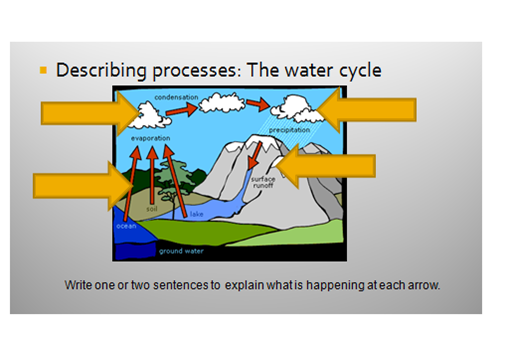
One of the things which less proficient writers find daunting about producing longer texts is the very fact that they are being asked to write something longer than a couple of sentences. Faced with the blank page, they will often simply tell you they don’t know what to write. As teachers, our job is to support them in this stage, helping them to develop strategies which will allow them to develop longer texts. For this reason, it is very important that longer writing tasks be done in class rather than for homework – the students will need individual support as they begin their writing. Once they are writing confidently they can be asked to finish their work for homework if need be. I find the best way to scaffold longer texts is to break down the requirements into smaller, more manageable parts. In Part II we saw an example of this with the water cycle exercise, Imagen water cyclewhere the students were asked to write one or two sentences about each step in the process, rather than simply being asked to write a paragraph describing the water cycle. On the worksheet the different steps are visually separated, so that what they are producing does not have the appearance of a long text. Once the students have produced their texts on the worksheet, you can ask them to copy the corrected version into their notebooks in the form of a paragraph, so that they realise how much they have been able to write, but only after they have successfully completed the worksheet. This enhances the sense of achievement, and success breeds success.

Picture stories are another useful way of breaking down longer more complex texts into more manageable parts. I use the stories from the speaking part of the Movers and Flyers exams, and in this way the students have more practise with the type of story they will face in the exam at the end of the year. You can see an example of one of these stories here, taken from Gray (2000).

Flyers Speaking Story

We can also get our students to make comic strips, producing their own pictures and adding text to each one. This can be done very simply by folding a piece of paper in half, in half again and in half again, which will divide the page into eight sections, for eight pictures. A more sophisticated alternative is to make a mini-book, instructions for which you can find here. This is a great way to check comprehension of something done in class, whether a story, or the steps in a process. I have used it to review extended reading, and to wind up work on biographies of famous people.

Collaborative writing

Another way to scaffold longer texts is to have students work together to create a text. This can be modelled using the ‘Mission Impossible!‘ activity, where each student has to create a correct sentence to form part of a story against the clock, with the teacher writing the story up on the board. Then put the students into groups of four and explain that each person will dictate one sentence of the text to the rest of the group. The other members of the group decide if they think the sentence is correct and appropriate or if it needs editing, and when they are all satisfied with the sentence they all write it down. Then the next person in the group dictates what they feel should be the next sentence in the text, and so on. This can be used to write picture stories, or any kind of text. It is very important that they have a clear idea of what they have to write about before they begin. I have used this to practise writing descriptions of places, projecting a photograph so that they are all describing the same place. This is also useful as practice for the Cambridge Preliminary (PET) speaking exam, where candidates are asked to speak for a minute about a photograph.

A slightly crazy version of collaborative writing can be a lot of fun for the end of term (although don’t expect great quality from the texts produced). Each student starts off with a piece of paper, and the teacher dictates the first sentence of a story, appropriate for the time of year or the topics being covered in class at that time. Each student then writes the next sentence in that story, and passes the paper to the student sitting next to him / her. each student then has to write the next sentence of the story they have in front of them before passing the paper on again. In this way you have as many stories circulating in the classroom as there are students, and each one will be different. As I have said, this is just a fun activity, but the students are still reading each text and writing, as well as revising what has been written before.

Final words

As I said at the beginning of this post, these activities may be suitable for primary students in some schools but more suitable for secondary students in other settings. The important thing is to get our students writing as early as possible, so that producing texts is seen as a normal part of the English (or CLIL) class. There are many other techniques we can use, and I hope that readers will share their own ideas through the comments section. One thing I have not touched on here is the use of technology in the writing class, and I hope to come back to that topic soon.

References

GRAY, E. (2000) Skills Builder for Young Learners: Flyers 1 – Student’s Book Newbury, Express Publishing.

Writing in Primary – Part II: CLIL

In the first post in this series, we looked at ways in which we can introduce young children to writing as part of their EFL class. In this post we examine the opportunities which CLIL gives us to extend and develop our students’ writing skills as they move up through the school, and how writing in the CLIL classroom can be linked to the external Cambridge exams.

Writing

(Photo credit: Wikipedia)

In the early science classes, students talk a lot about the classification of animals, and we make wall displays of the different classes of animals – fish, birds, amphibians, mammals and reptiles – with representatives of each class and the key 20120210_123850 (1)vocabulary for defining each class. The students’ attention is drawn to these labels in each lesson as we review and discuss different animals, so that they quickly become familiar with the vocabulary. Sometimes, before they come into the classroom, we move the words around, then get the students to help put them in the right places again, thus ensuring that the students are famiiar with reading the vocabulary. Once they are comfortable with the language, they can create a small project, writing about their favourite animal, using the key vocabulary from the unit and simple grammar structures such as ‘it’s’ and ‘it has got’, illustrating their texts with drawings or pictures cut out from magazines (or these days, downloaded from internet).

An extension of this exercise, and a much-loved activity each year, is the ‘Monster gymkhana’. Here, the students are working with the parts of the body, 20120210_123804 (1)numbers, sizes and colours, using the same verb structures as before. This activtiy begins as a reading exercise, seen here, a mute dictation in which the student has to draw the monster described in the photocopy and colour it appropriately. Once this has been done, the students are put into teams and given the task of designing their own monster. Then we take them out to the playground, where cut-outs of different body parts are distributed, legs in one place, arms in another, heads in a third, etc. Each set of cut-outs is labelled with the name of that body part. Each team of children is given a large card and some glue, and they race to find the different body parts they need to complete their monster design. We like to leave the finished monster designs on display in the playground so that the children can show their peers from other classes and their parents at playtime or after school. Once they have done the gymkhana itself, back in the classroom, each student writes the description of the monster they have constructed, and these descriptions can be added to the display.

These classification exercises use very simple grammar structures but at the same time they allow the students to express differences between items, which is used a great deal in the YLE speaking exams. In both Movers and Flyers, students are asked to spot the difference between two similar pictures, and in Movers they are also required to say which picture is the odd one out in a group of four, giving a reason.

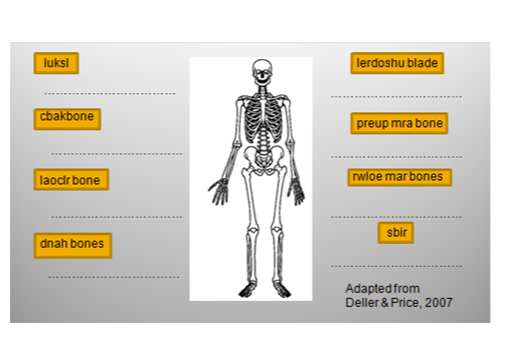
Imagen jumbled bones

(Adapted from Dellar and Price, 2007)

Another skill students need for the YLE exams is the ability to unjumble letters to form words, and this skill can also easily be practised in the CLIL class, as well as in the literacy class. For example, give students a worksheet where the different parts of the body are labelled on a skeleton,  but each part is jumbled, and the student has to write the items of vocabulary correctly. Here the student is focusing mainly on spelling of key vocabulary items, which may be more complex than the words which they usually employ in their writing.

As students progress they can be expected to write more, and here it becomes important that they learn to structure their texts. One way in which they can do this in the CLIL classroom is by describing processes, where there is a clear sequence to follow. Here is a worksheet on the water cycle, which they students are asked to label:

Imagen water cycle

However, instead of requiring the students to produce the key vocabulary, they are provided with the technical words on the diagram and asked to write one or two sentences to explain what is happening at each point in the process. Initially, the students are asked to write on each arrow, but as they gain confidence in this sort of exercise, they can be asked to write all their sentences together as a text, linking with sequencing words – ‘first’, ‘then’, ‘finally’. This scaffolding of longer texts will be the subject of the third post in this series.

Bibliography.

Deller, S. & C. Price (2007) Teaching Other Subjects Through English Oxford, Oxford University Press.