Simple, quick and fun. Guess what I’ll be doing in class next week.

http://www.teachthemenglish.com/2013/04/5-great-ice-breakers-in-5-days-1-where-in-the-world/

Simple, quick and fun. Guess what I’ll be doing in class next week.
http://www.teachthemenglish.com/2013/04/5-great-ice-breakers-in-5-days-1-where-in-the-world/
This post suggests a novel way of extending a running dictation exercise in class:

English: classroom (Photo credit: Wikipedia)
http://martinabex.com/2013/04/18/running-dictation-extension/
Here’s a link to another post about teaching writing, this time a webinar about teaching writing for young learners:

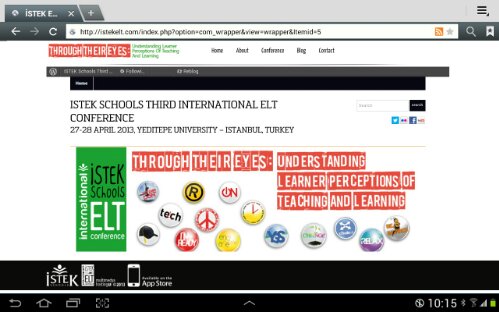
An introduction to another of the speakers at the ISTEK ELT Conference:
“In the lead up to the ISTEK Schools 3rd International ELT Conference, we’ll be introducing some of the presenters on the blog. Next up is Evridiki Dakos…
Could you tell us a bit about yourself?
Evridiki Dakos, the author of the Course Books Sparkle Grade 1, Sparkle Grade 2 and Sparkle Grade 3 is a graduate from Marmara University and has been teaching English for 22 years at Private Zografyon Greek High School while she has been teaching young and very young learners for the last decade. She has been awarded a CELTA certificate by University of Cambridge. She is a certified Pre-school Teacher by the Turkish Ministry of Education, Montessori Teacher Assistant, freelance Teacher Trainer, ELT speaker and Workshop Leader, ELT Blogger, University of Cambridge ESOL Exam Coach and Oral Examiner for YLE and KET/PET…” (Read more).

Here is a post from the OUP ELT Blog by Karen Frazer about a subject dear to my heart – teaching writing.

http://oupeltglobalblog.com/2013/04/16/teaching-writing-to-young-elt-learners/
This activity is one of those I described in my post ‘How to … exploit video in class’.
The objective is to get the students to produce a possible alternative script for this video clip. Play the video with the sound turned off, and ask the students to describe the situation which they see. If necessary play the video twice. Ask them where the men are, what their job is, and why the film is in black and white. Fill in cultural details as you consider necessary.
In pairs, the students should discuss what the men might be talking about, and what they have just heard on the radio. After sharing this in class, the students work in their pairs to write a possible dialogue which fits in with the changes of speaker on the video as closely as possible. Be prepared to play the video several times while they work so that they can check how well their script synchronises with the film.
Once the students have prepared and rehearsed their scripts, they perform them in time with the film in turn. I usually give them two attempts at this. It can be a nice touch to record them as they speak, then play back the recording in time with the film, so they can see how their words fit more clearly.
When all of the pairs have performed their scripts, the class watches the original version of the video with sound.
 LEVEL: Upper-Intermediate – Advanced (B2 – C2)
TYPES OF ACTIVITY: Speaking; Debate; Compare and Contrast; Essay writing.
OBJECTIVES: The principal objective of this lesson is to help students to develop critical thinking skills while comparing and contrasting two important world leaders. The activity models a structured approach to developing ideas for a writing task or for a class debate
To begin the class, write the following statement on the board:
Allow the students a couple of minutes’ thinking time, then have them discuss this statement in pairs, focusing on the personal qualities which they consider a leader should have. Once they have done this, join the pairs into groups of four and have them share their ideas. Then each group should report to the class, and an opportunity given to respond and comment. Possible lines of discussion to explore could be the difference between totalitarian and elected leaders, or the difference between being admired and being liked.
Tell the students they are going to read a short biography of a famous leader, and they have to make notes on the main points of the person’s life and decide what qualities they had as a leader. Give half of the class Worksheet A: Margaret Thatcher, and the other half of the class Worksheet B: Mahatma Gandhi. (Here is a link to the worksheets.)
Allow the students to compare their notes with another student working on the same worksheet. Then place the students in pairs with someone who worked on the other worksheet.
First, each student explains the main points of the biography of their leader, and suggests which personal qualities that leader had. Then the students work together to find differences and similarities between the two leaders, recording their answers on a graphic organizer such as a Venn diagram. They should focus on the personal qualities that make each leader different and which personal qualities they have in common, as well as the differences and similarities in their political and social situations.
Once the differences and similarities have been identified, each pair of students must decide which of these can be considered significant in the development of the leader, and draw conclusions about leadership from these significant similarities and differences.
There are different possibilities for a final task to this activity. One possibility would be to ask the students to write an opinion essay with the title ‘What makes a leader great?’ The students would use their notes and ideas from the discussion phase to illustrate their ideas, and to inform their analysis of different leadership styles.
Another possibility is for each pair of students to prepare an oral presentation on the two leaders, focusing on the similarities and differences in their personal qualities. For the presentations, the students should be encouraged to find further information about the personalities and political and social contexts of the two leaders, including recordings of them speaking about their ideas and policies.
Here’s a lesson plan from Kieran Donaghy that demonstrates a useful way of using video to stimulate discussion in class.

http://film-english.com/2013/04/15/make-it-count/
For more ideas on how to use video in class, click here.
learning to teach and teaching to learn
Free resources for language teachers by language teachers
This is my personal blog. I´m very interested in learning, teaching and sharing. I want to share ideas about teaching and learning, education technology and web tools to enrich my lessons as well as learn from all those who visit me here
Database of English language resources
Thoughts about personalized and adaptive learning in ELT

 David's ESOL Blog