Here’s a link to what promises to be a very interesting conference.


 LEVEL: Upper-Intermediate – Advanced (B2 – C2)
TYPES OF ACTIVITY: Speaking; Debate; Compare and Contrast; Essay writing.
OBJECTIVES: The principal objective of this lesson is to help students to develop critical thinking skills while comparing and contrasting two important world leaders. The activity models a structured approach to developing ideas for a writing task or for a class debate
To begin the class, write the following statement on the board:
Allow the students a couple of minutes’ thinking time, then have them discuss this statement in pairs, focusing on the personal qualities which they consider a leader should have. Once they have done this, join the pairs into groups of four and have them share their ideas. Then each group should report to the class, and an opportunity given to respond and comment. Possible lines of discussion to explore could be the difference between totalitarian and elected leaders, or the difference between being admired and being liked.
Tell the students they are going to read a short biography of a famous leader, and they have to make notes on the main points of the person’s life and decide what qualities they had as a leader. Give half of the class Worksheet A: Margaret Thatcher, and the other half of the class Worksheet B: Mahatma Gandhi. (Here is a link to the worksheets.)
Allow the students to compare their notes with another student working on the same worksheet. Then place the students in pairs with someone who worked on the other worksheet.
First, each student explains the main points of the biography of their leader, and suggests which personal qualities that leader had. Then the students work together to find differences and similarities between the two leaders, recording their answers on a graphic organizer such as a Venn diagram. They should focus on the personal qualities that make each leader different and which personal qualities they have in common, as well as the differences and similarities in their political and social situations.
Once the differences and similarities have been identified, each pair of students must decide which of these can be considered significant in the development of the leader, and draw conclusions about leadership from these significant similarities and differences.
There are different possibilities for a final task to this activity. One possibility would be to ask the students to write an opinion essay with the title ‘What makes a leader great?’ The students would use their notes and ideas from the discussion phase to illustrate their ideas, and to inform their analysis of different leadership styles.
Another possibility is for each pair of students to prepare an oral presentation on the two leaders, focusing on the similarities and differences in their personal qualities. For the presentations, the students should be encouraged to find further information about the personalities and political and social contexts of the two leaders, including recordings of them speaking about their ideas and policies.
Here’s a lesson plan from Kieran Donaghy that demonstrates a useful way of using video to stimulate discussion in class.

http://film-english.com/2013/04/15/make-it-count/
For more ideas on how to use video in class, click here.
All the news from the ISTEK Schools conference for those of us who can’t be there:
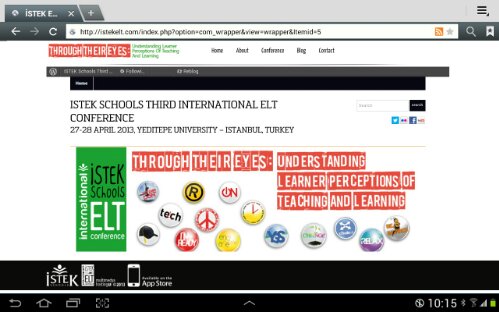
http://istekelt.com/index.php?option=com_wrapper&view=wrapper&Itemid=5

In the lead up to the ISTEK Schools 3rd International ELT Conference, we’ll be introducing some of the presenters on the blog. First up is Nina Lauder.
Could you tell us a bit about yourself?
I am active, energetic…and very messy at home! I love doing sports, travelling, going to the cinema and reading. I have a camper van and try to spend time in the summer by the sea or in the countryside.
 What is your teaching background?
I started working with children and teenagers when I was a teenager myself. When I was young, I worked as a volunteer with special needs children, children from other countries who needed language training, children from abusive homes and for a year with teenagers who had suffered permanent spine or neck injuries in hospital. Over 20 years ago I started teaching ELT in Greece and have been teaching and working with…
View original post 229 more words
This is a very clear and extensive explanation of what cooperative learning is, and what advantages it brings to the classroom, while the comments reveal some of the preoccupations teachers have about this methodology.

Cooperative learning (Photo credit: Institut Escola Les Vinyes)
http://www.educationnews.org/higher-education/whats-happening-to-cooperative-learning/
David’s ESOL Blog has reached 3000 hits! Many thanks to everyone who has paid a visit.

Here’s another link to an online newsletter with lots of useful information:

Her’s a link to an online ESL newsletter with plenty of interesting articles for the EFL / ESL teacher:

learning to teach and teaching to learn
Free resources for language teachers by language teachers
This is my personal blog. I´m very interested in learning, teaching and sharing. I want to share ideas about teaching and learning, education technology and web tools to enrich my lessons as well as learn from all those who visit me here
Database of English language resources
Thoughts about personalized and adaptive learning in ELT

 David's ESOL Blog