
A vey interesting topic, presented here. I always stress the importance of peer observation in the departments I work in. Unfortunately, too often it is used as a tool by the management to ‘assess’ teachers, without a clear focus on professional development, and this makes many colleagues wary of being observed, even by other teachers. Thank you Vicky for focusing on this topic. http://vickyloras.wordpress.com/2013/03/07/observe-and-be-observed-pd-in-focus-4/?blogsub=confirming#subscribe-blog
Free Technology for Teachers: Padlet Streams – A Simple Way to Create a Group Blog
Here’s a link to a very useful blog for all of us who want to include ICT in our classrooms on a minimum budget:

http://www.freetech4teachers.com/2013/03/padlet-streams-simple-way-to-create.html#.UTipDPu3PMI
This corpora-bashing parrot has ceased to be | EFL Notes
An interesting article, and an interesting debate.
http://eflnotes.wordpress.com/2013/02/03/this-corpora-bashing-parrot-has-ceased-to-be/
Speaking Activity: Mission Impossible!

This speaking activity is designed to help your students to revise their written work and improve their critical reading. It is quite a flexible activity, and can be used as a warmer or as a prize at the end of a lesson, or it can form the basis of a lesson in itself.
-
Explain to the students that they are going to create a story as a class, but that the exercise is timed. (I like to play the music from ‘Mission Impossible’ to introduce the lesson – this introduces a sense of urgency.) The time limit depends on the level of the group. I usually use five minutes to begin, then reduce the time as they become more familiar with the game.
-
The timing can be done with a stopwatch on a computer, if possible projected so they can all see the time, or with an egg-timer, preferably one with a loud tick. In any case, they students should have some object which they can pass to indicate whose turn it is, representing the bomb – if they are not passing an egg-timer, a ball will do, but they should pass it carefully, not throw it!
-
The first student is handed the bomb and is told to be very careful! Their task is to dictate the first sentence of a story to the teacher, who will write it on the board. Write what the student says, without judgement, but do not put the full stop until you are satisfied that the sentence is correct. You should not tell the student where the errors are – they must find them and correct them with the help of the rest of the class. Once the sentence is correct, the student can pass the ‘bomb’ to the next student, who has to continue the story with the next sentence.
-
The students each take a turn to add a sentence to the story being created, until the time runs out (the egg-timer rings, or the timer on the board / computer sounds – try to chose a fairly strident sound if possible). The student who is working on his / her sentence when the time finishes is eliminated.
-
If you play several rounds of this game, it is a good idea to make the final round a ‘Zombie’ round, in which only the people eliminated take part. This brngs them back into the lesson, and gives them a second opportunity. I find that they are normally much more careful when revising their work than the first time around.
8 Must Have Open Source Apps for Teachers | Teach Amazing!
An interesting post that shows how we can begin to make use of technology to support our classes without spending lots of money:

http://teachamazing.com/8-must-have-open-source-apps-for-teachers/
Upcoming Events: TESOL Spain Annual National Convention
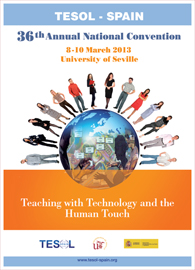
The 36th TESOL Spain Annual National Convention is on from 8th March to 10th March with the Title ‘Teaching with Technology and the Human Touch’. The venue this year is The Universidad de Sevilla. As always, there are many interesting talks and workshops in the programme. Take a look at the pre-programme here.
I will be giving my talk ‘Peer response in the writing process‘ in Room 204 on Saturday 9th March at 10:45, and on Sunday 10th March I will be running my workshop ‘Getting them speaking‘ in Room 203. I hope to see you there.
Sound advice on how to approach a conference – particularly with TESOL Spain only three days away!

This is the summary of the first #eltchat on Wednesday 14th March 2012. To find out exactly what #eltchat is, click here.
With IATEFL 2012 fast approaching and in the midst of the spring conference season, this #eltchat was aimed at helping both those who can and can’t attend conferences to get the maximum possible benefit from them.
Before you go
Try to research the people and organisations who will be there. Find people on Twitter if possible – this should make it easier to recognise new faces.
Research speakers you plan to see – this will help you to decide which sessions to attend.
Make sure your bags aren’t too full – there is always something which you must buy!
While you’re there
Go to sessions you’re most interested in, not just because you feel you SHOULD go to a certain session. Do you really want…
View original post 772 more words
Evidence Based EFL: If you need to explain why it’s wrong…
Cambridge English: Advanced – Paper 2, Writing
An explanation of the format of the writing paper in the Cambridge English: Advanced (CAE) exam from the University of Cambridge.
The 50 Best Smartphone Apps for Back to School: The Teacher Edition
A great post to help us get the most out of our smartphones and tablets:

 David's ESOL Blog