Teacher, trainer and writer Ceri Jones talks about herself and her session at The Image Conference.
Your favourite film:
I always find any question with “favourite” in it so difficult to answer. My mind immediately either goes blank and I either can’t even think of one example or a huge list parades before my inner eye and I can’t possibly start to rank or choose one out of so many options. And then the fear kicks in that I will be judged for my answer. These things can be so telling, people will tut and shake their heads (or that’s what my inner voice is telling me). My usual strategy to overcome my natural instinct to just shrug and say “dunno, haven’t got one” is to grasp at the first that comes to mind. Of course, that means the answer will probably be different each time, and dictated by so…
The closing date for receipt of speaker proposals for the TESOL France Colloquium is 30th June. For more details and the Speaker Proposal form, visit the link below.
In this post, Jim Scrivener explains the proposal for ‘demand high’ ELT he has made with Adrian Underhill at last month’s IATEFL Conference in Liverpool. We have already examined ‘Demand High’ in a previous post, ‘Demand high ELT – an interesting challenge‘.
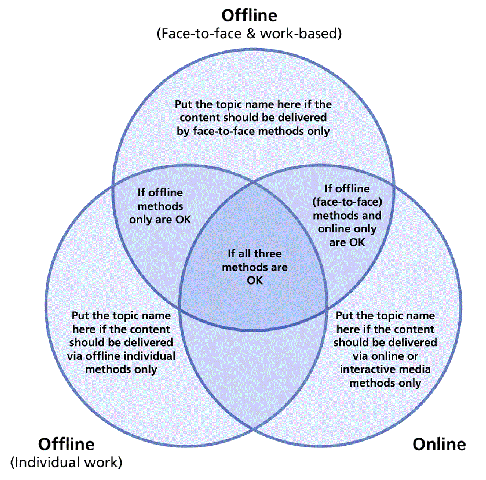
In my previous post I looked at possible definitions of blended learning. Having seen what it is, or at least some of the possibilities, in this post I would like to share some of my sources which refer to the advantages of blended learning.
One of the advantages which are attributed to blended learning is that it frees up classroom time for more creative, cooperative exercises, with the basic learning input which is needed, the building blocks as it were, being provided online. Here is a video from the Khan Academy, pioneers in this form of learning, in which the founder, Salman Khan, explains this:
Terry Heick describes 4 benefits of blended learning in his article on the Teach Thought. blog. For Heick, The benefits of taking online and face-to-face classes are linked to a students employability after college. For example, online and face-to-face classes emphasise different aspects of effective communication, all of which are important in the increasingly globalised business world. Also, being able to follow an online course demonstrates that a student has the digital fluency necessary to function professionally, and that s/he has the self-discipline necessary to work autonomously.
The University of Central Florida offers a Blended Learning Toolkit online, which suggests that the benefits of blended learning are that it can be used to breathe new life into established courses by incorporating different forms of interaction into the class, introduces the advantages of an online course without losing the social interaction element of a traditional classroom which is difficult to achieve online, and from an administrative point of view, can free up much-needed classroom space.
Finally, I must mention Thomas Stanley’s series of posts, again on Teach Thought, which examines the different interactions within a blended leaning model of education. The first post in the series looks at possible ways of setting up a blended learning course, suggesting that the online element could introduce the real world into the classroom, allowing students to use that element to enhance their class projects, engaging the students far more than more traditional approaches. In the second part, Stanley focuses on student to student interaction within a blended learning context, examining how this can be realised using both synchronous and asynchronous online tools.
Photo attribution Flickr user flickeringbrad
In part three, Stanley looks at the role of the teacher in a blended learning model, suggesting a shift in that role from providing instruction to accompanying students as they learn, a ‘guide by the side’. This is a result of the more inquiry-based learning approach suggeted in part one of this series. This approach allows for more individual tutoring from the teacher for each student as they work through the programme of inquiry designed by the teacher, enabling him / her to evaluate the thinking process of the students more closely. The teacher is also responsible for suggesting resources which the students can use and guiding them in their inquiry, and in their evaluation of their progress.
The Association of English Teachers in the Canaries has just published their call for papers for their 30th Annual Conference, which this year will take place 14th – 16th November in Las Palmas de Gran Canaria.
To celebrate their 30th anniversary, they have curated a Scoop It! page with different speakers who have presented at the TEA conference over the years, which you can see here.
For information about last year’s conference, in Tenerife, visit my page here.
Over the last few days I have been looking into the topic of blended learning, and I thought I would share some of the sources which I have found useful in my research.
To begin with, we should have some definition of what blended learning is. Here is a video from Education Elements on You Tube which explains what blended learning is:
In a previous post we looked at an infographic of the flipped classroom. And here is a more detailed definition from Terry Heick, on www.teachthought.com . Blended learning has many names: the flipped classroom, hybrid learning, blended education… Basically it is the combination of traditional classroom instruction with online elements designed to enhance the learning experience for the students (and hopefully for the teacher). This goes beyond uploading a video for the students to watch at home; the integration of online material into the learning environment should be carefully planned and ‘pedagogically valuable’ (Heick).
Obviously, wth such a definition, there is a wide range of interpretations of what blended learning should look like. Here is an infographic, again from Teach Thought, which explores six different types of blended learning:
In the next post, Blended Learning (II), we will examine some sources which explain the advantages of blended learning as opposed to traditional face-to-face instruction.
Here is a link to Marisa Constantinides’s report on her extremely interesting talk ‘Defragmenting foreign language learning’, given at TESOL Greecethis year:
This is my personal blog. I´m very interested in learning, teaching and sharing. I want to share ideas about teaching and learning, education technology and web tools to enrich my lessons as well as learn from all those who visit me here








 David's ESOL Blog